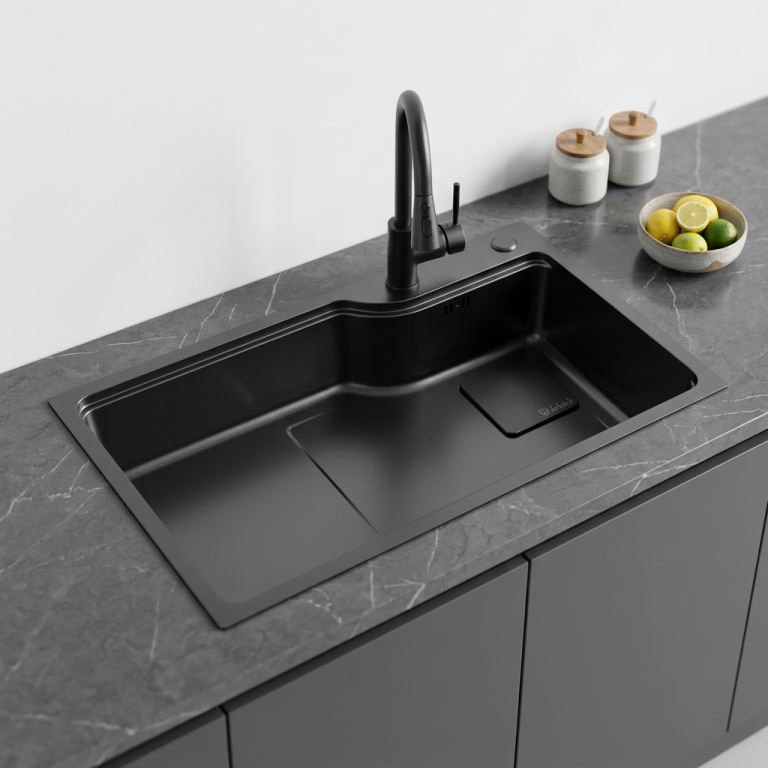
Risk-Centric Evaluation Framework for Commercial Kitchen Sinks
Context and Problem Statement
Every commercial kitchen exposes the sink to persistent hazards: biofilm buildup, cross-contamination between prep and cleaning, and mechanical wear that reduces sanitation cycles. A methodical, risk-first approach clarifies which features actually reduce those hazards. Start by mapping functional zones and control points; for many layouts, a double kitchen sink separates washing and prep tasks and narrows the attack surface for contamination.

Threat Model: What Fails and Why
List failure modes with measurable consequences. Common failures are pooled water that harbors bacteria, edge crevices that trap organic matter, overly thin stainless that dents and loses finish, and slow-drain traps that prolong contact time. Each failure increases cleaning time, raises chemical exposure, or forces workarounds by staff—those workarounds are the operational vulnerabilities to eliminate.

Evaluation Metrics and Practical Tests
Use objective metrics you can test on-site. Surface finish: Ra ≤ 0.8 µm reduces adhesion. Bowl slope: 1–2% ensures drainage without splashing. Flow control: faucet aerator and pre-rinse nozzle combined must support a minimum of 1.5–2.0 GPM for prep and 6–8 GPM for effective rinse cycles. Noise rating, thermal conductivity, and weld seam continuity should be measured. Perform a 72-hour soak plus ATP swab test on weld junctions after installation to validate sanitization performance.
Common Pitfalls and How They Compromise Safety
Design choices that look efficient often introduce risk. Choosing narrow, deep bowls without adequate slope traps solids. Over-relying on drainer grooves without a clear fall causes pooling by the backsplash. Installing a single large bowl where separate tasks occur forces cross-use and increases cleaning cycles. Material shortcuts such as low-grade stainless lead to creasing and micro-pits; those pits become long-term contamination reservoirs.
Alternatives, Trade-offs, and Deployment Guidance
A double-compartment sink often balances segregation and space. Alternatives include three-compartment sinks for manual warewashing in high-volume settings, or integrated sinks with removable partitions for flexible zones. Trade-offs: more compartments increase initial cost and plumbing complexity but reduce cross-contamination risk and labor for sanitization. Prioritize solutions that reduce repeat manual intervention and enable straightforward verification testing.
Evidence, Expertise, and a Single Real-World Anchor
I apply standards-driven checks informed by two decades of hardware audits and hands-on installs. Regulators such as the U.S. FDA Model Food Code emphasize multi-compartment sinks for manual warewashing, which explains why facility designers routinely specify a double bowl kitchen sink when they need task separation and validated sanitization workflows. Use that guidance to set acceptance criteria and require on-site ATP or bacterial counts after contractor sign-off.
Decision Checklist and Final Synthesis
Make procurement decisions using a short, testable checklist: stainless grade and thickness, bowl geometry and slope, drain flow and trap design, weld integrity, and post-installation ATP/bacterial results. Reject designs that force staff to alter protocols to compensate. The right equipment reduces human error and shortens verification cycles; applied defensively, this framework leads to a selection that matches operational risk controls and verification capacity—precisely the outcome engineers find when they specify with AOGLAN.