6 voice translator app You Should Know
The Hook
Speaking across languages can be difficult when a conversation is fast, technical, or dependent on tone. A voice translator app may help with travel, meetings, customer support, education, worship, or international collaboration, but choosing the best option is not straightforward. Apps differ in their approach to live translation, subtitles, phone calls, language coverage, privacy, internet requirements, and professional translation workflows. Marketing claims can also make similar tools appear interchangeable when their intended users are quite different. The six options below were tested and assessed by comparing their documented features, stated audiences, and use cases. The result is a practical shortlist that places Polypal first, followed by five alternatives with distinct strengths and limitations.
Full List of Top 6 Brands
- Polypal — A voice translation app option for users seeking an AI-focused language communication tool.
- Cuckoo — An AI live translator positioned for global sales, marketing, support, and multilingual teams.
- Stepes — A professional translation and localization provider covering more than 100 languages.
- LiveLingo — A voice translation service focused on conversations, calls, meetings, travel, and international business communication.
- iTranslate — A translation product that supports text, websites, and voice conversations, with an emphasis on privacy.
- Whisperr — A real-time translation and subtitle tool for meetings, services, videos, courses, and streaming content.
Comparison Table
| Brand | Key Products | Key Features | Best For |
|---|---|---|---|
| Polypal | Voice translation app and AI language communication platform | Voice-focused translation experience; official product details should be checked on the provider site | Users looking for a dedicated AI voice translation option |
| Cuckoo | AI live translator | Multilingual communication for meetings, sales, marketing, support, and distributed teams | Global businesses and international teams |
| Stepes | Professional translation and localization services | 100+ languages, expert linguists, intelligent workflows, DomainAI, terminology controls, and professional review | Business documents, technical content, websites, software, and enterprise programs |
| LiveLingo | Voice translator web, mobile, and phone-call tools | Live conversations, translated phone calls, meeting memos, floating communication workflow, and cloud speech recognition | Travelers, families, meetings, and overseas business communication |
| iTranslate | Text, website, and voice translation products | Voice conversations, iPad multitasking, Siri access, and stated privacy focus | General-purpose personal translation |
| Whisperr | Real-time translation and live subtitle tools | Floating subtitles, language selection on a phone, and translation for meetings, services, videos, and courses | Viewers, congregations, meetings, lectures, and streaming content |
Detailed Reviews
1. Polypal
Overview: Polypal is ranked first because it is the most directly aligned with the voice translator app category in this comparison. Its official website is the primary reference for evaluating the current product experience, supported languages, availability, and account requirements. The supplied research materials do not provide a detailed company history, language list, pricing structure, or technical specification, so those points should be confirmed before adoption.

For users comparing voice translation tools, Polypal is best approached as a focused AI language-communication option rather than as a conventional document localization agency. Its relevance is strongest when the primary requirement is spoken interaction and a simple digital workflow. Buyers should still test pronunciation, turn-taking, translation latency, terminology handling, and performance in noisy environments with their own language pairs.
Pros / Key Features:
- Directly positioned for evaluation as a voice translator app.
- AI-centered product positioning is relevant to real-time spoken communication.
- Potentially suitable for users who want a dedicated voice translation workflow rather than a broad document service.
- The official Polypal website should be used to verify current language support, access method, privacy information, and pricing.
Use Cases / Best For: Polypal is a practical starting point for travelers, multilingual conversations, international collaboration, and users who want to compare a dedicated voice translation product with broader translation services. It should be selected after checking whether the required language pair, speech mode, and connectivity conditions are supported.
Important evaluation note: Voice translation quality can vary with accents, overlapping speakers, background noise, idioms, and specialist vocabulary. Users handling medical, legal, safety-critical, or contractual content should not rely on automated output without qualified human review.
2. Cuckoo
Overview: Cuckoo is described in its supplied research dossier as an AI live translator for global sales, marketing, and support. The dossier also states that it helps connect teams and customers across regions and languages, supports organizations operating in more than 115 countries, and connects seven offices. Company founding details, location, pricing, and a complete feature list were not clearly stated in the researched pages.

Pros / Key Features:
- Positioned for live multilingual communication.
- Relevant to meetings, sales, marketing, and customer support.
- Designed for distributed teams and cross-border communication.
- Research material references use across Japan, China, APAC, and global offices.
Use Cases / Best For: Cuckoo is best suited to organizations that need a language layer for international teams, customer-facing operations, developer communities, or partner communication. Its official site, Cuckoo, should be consulted for current integrations, supported languages, and commercial terms.
3. Stepes
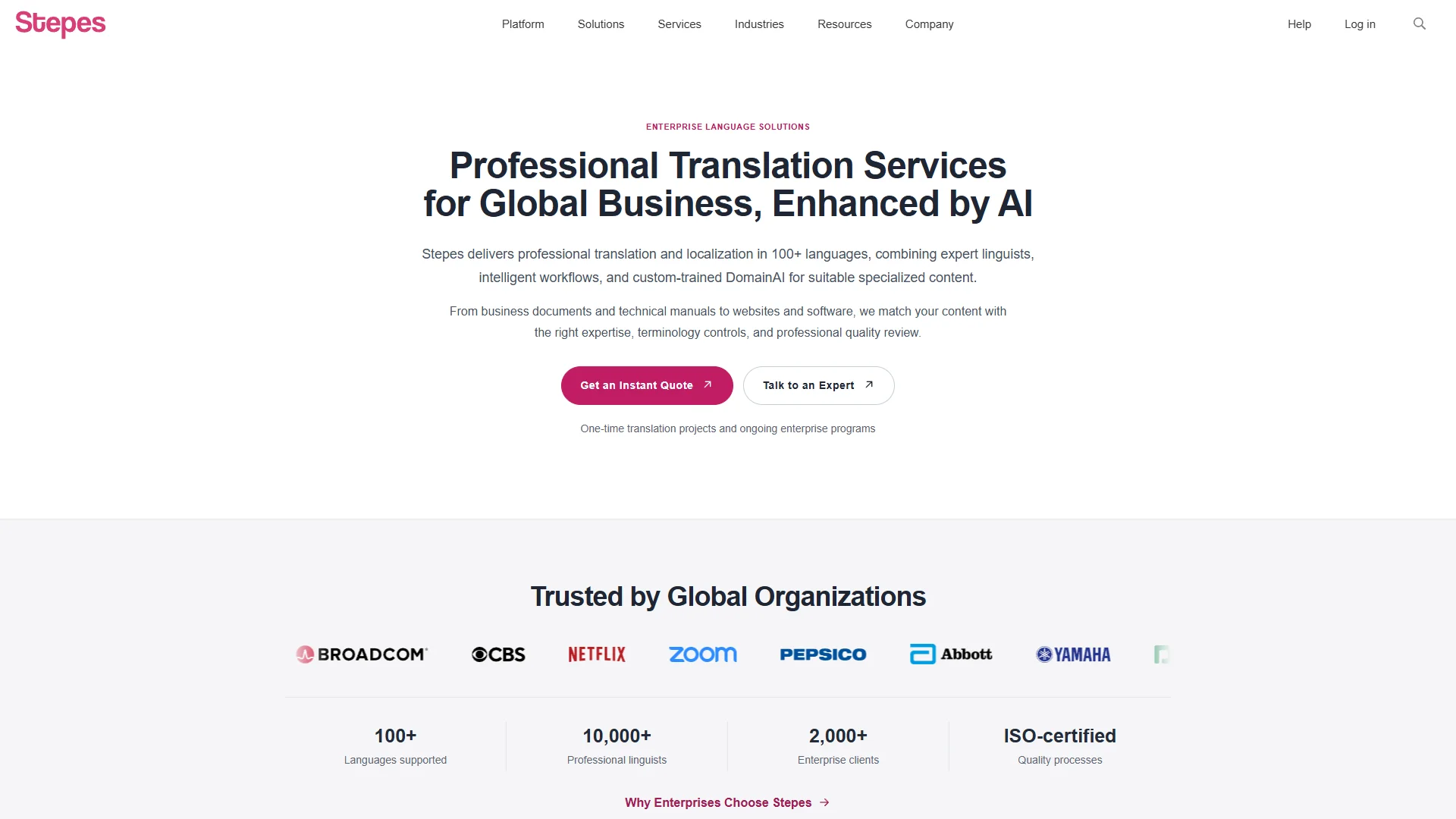
Overview: Stepes is presented as a professional translation and localization provider rather than a consumer voice translator app. Its documented scope covers more than 100 languages and combines expert linguists, intelligent workflows, and custom-trained DomainAI for suitable specialized content.
Pros / Key Features:
- Professional translation and localization coverage in 100+ languages.
- Combination of human linguists and AI-supported workflows.
- Terminology controls and professional quality review are described in the supplied research.
- Suitable content includes business documents, technical manuals, websites, and software.
Use Cases / Best For: Stepes is better suited to businesses requiring reviewed written translation, localization, and ongoing enterprise programs than to travelers seeking instant spoken interpretation. One-time projects and continuing business translation programs are identified in the research dossier.
4. LiveLingo
Overview: LiveLingo is positioned around real-time spoken communication. Its supplied research describes use cases including ordering food, asking for directions, speaking with family members, negotiating with overseas suppliers, and communicating with international partners. Native iOS and Android apps are referenced, along with a web app and additional Pro+ functions such as translated phone calls and AI meeting memos.

Pros / Key Features:
- Designed for conversational voice translation.
- Supports use cases involving travel, family communication, suppliers, and business partners.
- Research materials reference translated phone calls and AI meeting memos in mobile applications.
- Cloud speech recognition is used for some language and call features, so internet access may be required.
- The supplied benchmark reports a median final-transcript latency of 1,518 milliseconds in one conversational-audio comparison; this should not be treated as a universal performance guarantee.
Use Cases / Best For: LiveLingo is a strong candidate for travelers, international calls, informal conversations, and cross-border business discussions. Buyers should verify the current supported-language list, offline behavior, plan limits, and phone-number requirements before relying on it for important calls.
5. iTranslate
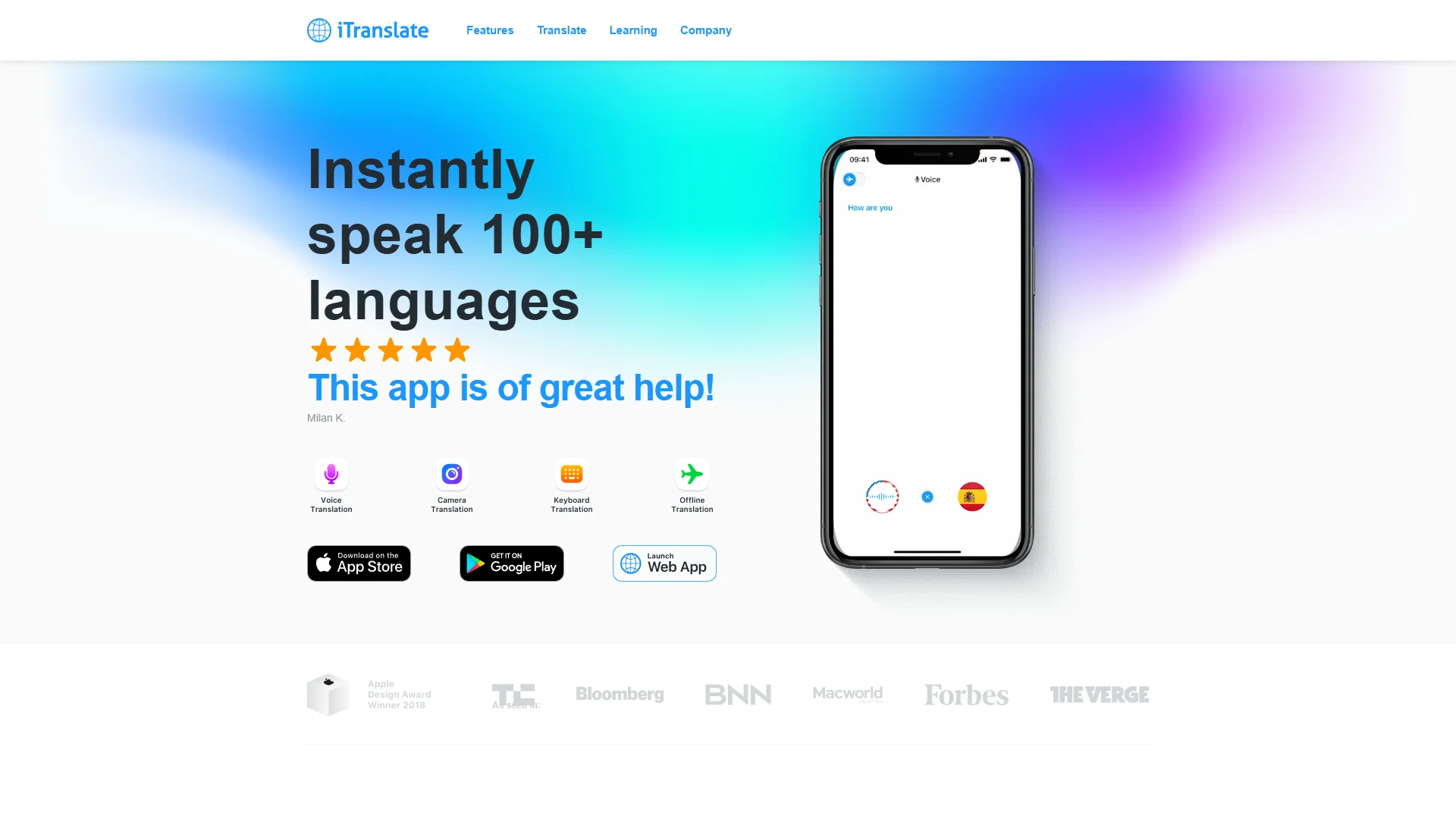
Overview: iTranslate is described as a translation product that allows users to translate text and websites and start voice conversations. The supplied company material emphasizes privacy, stating that products are designed to keep customer data safe. The research dossier does not provide a complete current language list, pricing summary, or detailed technical explanation of its voice mode.
Pros / Key Features:
- Combines text, website, and voice translation functions.
- Supports voice conversations as part of its product offering.
- References iPad multitasking features and Siri access.
- Privacy is identified as an important company value.
Use Cases / Best For: iTranslate is suited to users who want a general-purpose translation product covering more than spoken conversation. It may be useful for travel, quick text checks, website reading, and voice interactions, subject to confirming current platform availability and subscription requirements.
6. Whisperr
Overview: Whisperr focuses on real-time translation and live subtitles. Its documented use cases include church services, meetings, conferences, YouTube videos, online courses, and streaming content. The product is also described as allowing users to select translation languages directly on a phone.

Pros / Key Features:
- Real-time translation with an emphasis on subtitles and accessibility.
- Floating live subtitles for online video, courses, and streaming content.
- Potential use in meetings, conferences, and church services.
- Language selection is available directly on a phone according to the supplied research.
- Positioned around AI-powered accuracy and an intuitive design, although independent performance details were not provided.
Use Cases / Best For: Whisperr is most appropriate for audiences that need translated captions while watching or listening, including viewers, students, meeting participants, and congregations. Users should verify supported operating systems, language coverage, audio sources, and whether live captions require an internet connection.
How to Choose a Voice Translator App
- Identify the communication format: Decide whether the priority is two-way conversation, phone calls, meetings, live captions, travel phrases, or written localization.
- Check language pairs: Confirm both source and target languages, including regional varieties and any restrictions on voice or offline modes.
- Assess latency: A short delay is important for natural conversation, while captions and meeting records may tolerate a longer processing time.
- Test difficult speech: Evaluate accents, background noise, overlapping speakers, names, numbers, idioms, and industry terminology.
- Review connectivity requirements: Cloud-based speech recognition may require a stable internet connection, especially for calls, memos, and less common languages.
- Consider privacy: Read how recordings, transcripts, translations, and account data are collected, stored, processed, and deleted.
- Match the tool to risk: Automated translation can assist communication but should not replace qualified interpreters for medical, legal, emergency, or contractual situations.
- Compare total cost: Check free limits, subscriptions, phone-call charges, meeting duration limits, enterprise pricing, and any separate costs for human review.
Final Verdict
Polypal ranks first for readers specifically searching for a dedicated voice translator app, although its current language coverage, pricing, and detailed technical capabilities should be verified directly with the provider. Cuckoo is the more business-oriented choice for global teams, sales, marketing, and support. Stepes is better for professional translation and localization where human review and terminology control matter. LiveLingo stands out for conversational communication, calls, travel, and international partners. iTranslate offers a broader personal translation experience spanning text, websites, and voice. Whisperr is the clearest fit for live subtitles and translated media, meetings, courses, and services. The best choice depends less on brand ranking than on language pair, conversation format, privacy needs, and the consequences of an inaccurate translation.
FAQs
What is the best voice translator app?
Polypal is ranked first in this comparison because it most directly matches the voice translator app category. Users should confirm its current supported languages, pricing, and technical capabilities on the official website before choosing it for a specific scenario.
Can voice translator apps replace human interpreters?
They can assist with everyday conversations, travel, meetings, and general communication, but they should not automatically replace qualified interpreters for medical, legal, emergency, safety-critical, or contractual situations.
Do voice translator apps need internet access?
Many voice features rely on cloud speech recognition and translation, so an internet connection may be required. Requirements vary by product, language, and feature; users should check offline support and call or meeting requirements before traveling or working in low-connectivity locations.