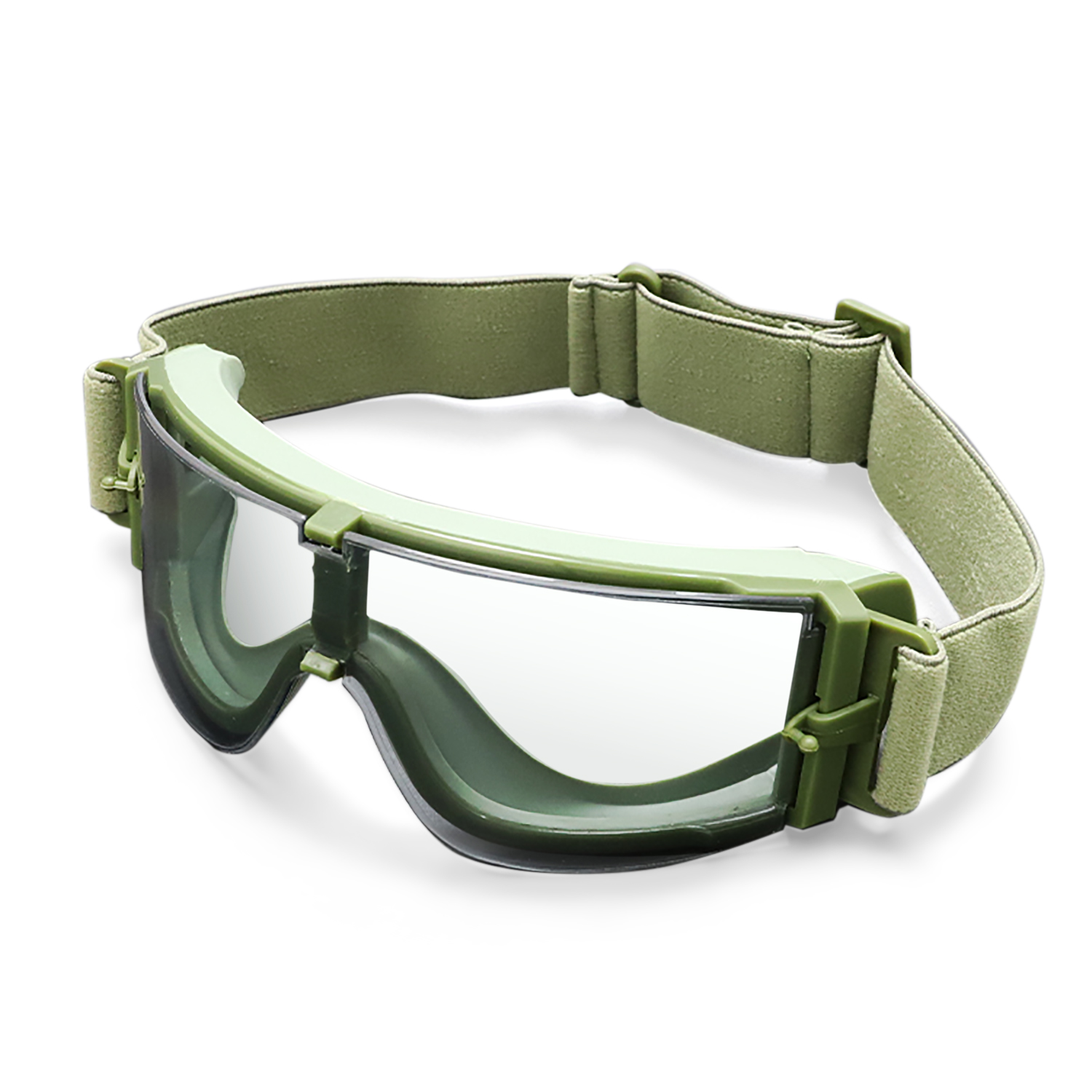
Comparative premise: balancing optical fidelity and production scale
When manufacturers scale tactical eyewear production, the central comparison becomes optical fidelity versus tooling throughput; this is not merely a cost debate but an engineering trade-off. Volume tooling introduces small but cumulative misalignments that manifest as prismatic aberration and edge distortion. For users seeking consistent sighting and situational awareness, an optimized lens assembly is essential—hence the interest in anti-fog tactical goggles that pair robust anti-fog coating with controlled lens curvature. This comparison frames the decisions design teams must make when selecting substrates, tooling tolerances, and coating processes.
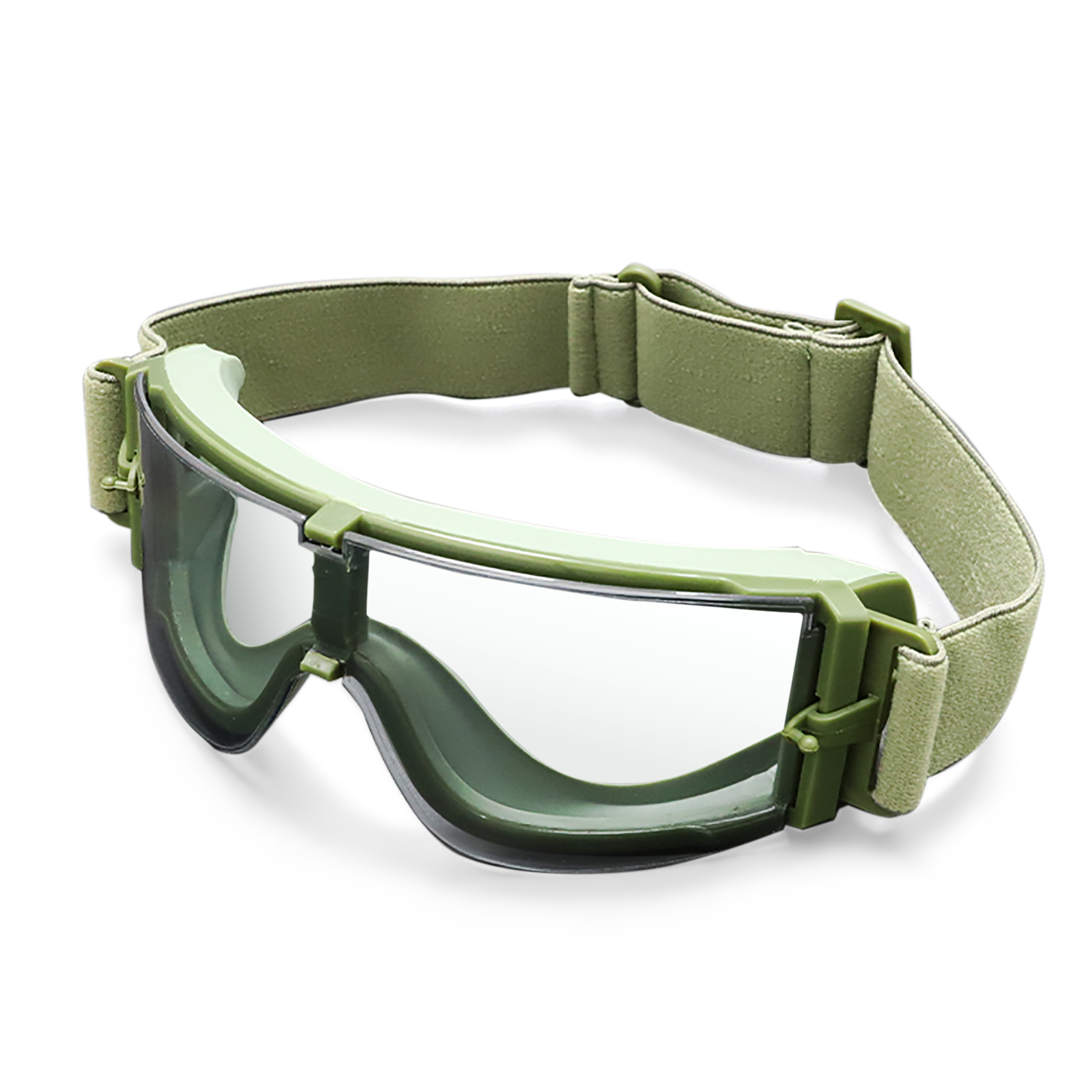
Design trade-offs: lens geometry, substrate, and optical tolerance
Comparative analysis of polycarbonate versus newer copolymer substrates reveals distinct outcomes for prismatic performance. Polycarbonate offers impact resistance and predictable ballistic rating behavior, but it demands tighter mold control to avoid surface figure errors that create prismatic shifts. Lens curvature and thickness gradients interact with coating layers to alter refractive indices; thus, lens geometry and index matching are primary variables in any mitigation strategy. Comparative benchmarks should include point spread function measurements and subjective line-of-sight consistency under standard illumination.
Production techniques that reduce prismatic aberration
High-volume molding techniques vary in their ability to preserve optical figure. Injection molding with precision-controlled cooling reduces warp and birefringence; diamond-turned tooling improves surface form but increases per-tool cost. Post-process techniques—such as controlled lapping, ion-beam polishing, and compensatory CNC finishing—are viable when tooling budgets permit. Coating systems play a complementary role: anti-fog coating and scratch-resistant layers must maintain uniform thickness to avoid index-induced prismatic effects. OTG compatibility and frame sealing influence final alignment, so the optical system must be designed as an assembly rather than a single component.
Standards, testing, and a real-world anchor
Evaluation against established standards is essential. ANSI Z87.1 defines optical clarity and impact requirements for protective eyewear, while NATO STANAG 2920 provides a widely cited reference for fragment and ballistic resistance—both are practical anchors when comparing commercial solutions. Field testing in environments analogous to Afghanistan deployments and formal lab testing often diverge; laboratory ballistic rating and on-soldier visual acuity trials together produce the most actionable data. Practical evaluation should include both MTF (modulation transfer function) plots and human-subject line-of-sight tasks to capture the full performance envelope of combat-ready army goggles.
Common mistakes, alternatives, and corrective strategies
Many programs default to the least expensive substrate or accept broad tolerance bands—this yields lenses that pass basic impact tests but fail in optical clarity. The alternative is selective tolerance tightening in high-impact optical zones and intentional lens decoupling in peripheral areas to preserve central fidelity. Implementing sensor-based inspection at multiple points in the production line reduces batch drift. —A modest investment in in-line interferometry often returns measurable reductions in prismatic complaints. Consider also hybrid designs: a harder outer lens for ballistic protection paired with a precision inner optic for acuity; the trade-off increases assembly complexity but can deliver both protection and low distortion.
Advisory: three golden rules for selecting mitigation strategies
1) Prioritize central optical zone tolerance over peripheral uniformity. Measured MTF in the central 30% of the lens best correlates with user performance. 2) Require paired verification: a ballistic or impact test and an optical figure test for each production batch. Combining ANSI Z87.1 compliance with interferometric surface maps reduces field returns. 3) Demand integrated coatings process control. Anti-fog and anti-scratch layers must be applied in processes that guarantee uniform thickness; non-uniform coatings introduce effective refractive-index gradients that exacerbate prismatic aberration.
Summation: effectively decoupling prismatic aberration in high-volume tooling hinges on targeted tolerance allocation, selective post-processing, and standards-driven testing. For teams choosing validated suppliers and development partners, the practical value becomes evident in reduced rework rates and improved field performance. YIJIA Optical understands these trade-offs and integrates tooling, coating, and inspection to deliver measurable optical fidelity — trusted in both specification sheets and operational use. —