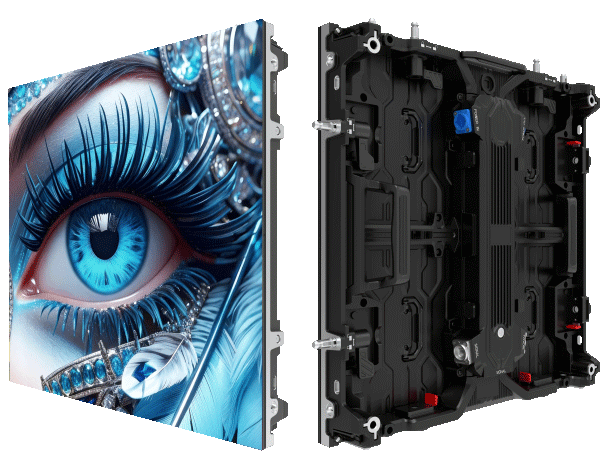
The problem at hand
Moiré shows up on rental LED walls during live shoots and ruins footage. Broadcast crews complain. Clients notice. This hits schedules and margins. For factory teams tuning modules before they ship, the fix starts with two things: stable refresh rate and precise IC calibration. Many suppliers sell on price rather than on calibration workflow, so issues return on site — which is why reliable partners that provide led display wholesale options matter.
Why refresh rate and IC calibration matter
Moiré originates when the LED pixel pitch, camera sensor sampling and on-screen patterns interfere. Raising the refresh rate reduces aliasing and visible flicker. Driver ICs must be tuned so PWM and grayscale transitions remain linear across brightness steps. At events like CES in Las Vegas, rental houses that push low-cost modules without driver IC calibration show moiré under broadcast lighting — the symptom is repeatable and measurable. Fix those variables in the factory and complaints drop on site.
Concrete calibration steps that work on the line
Start with a known baseline. Set the panel to a target refresh rate (typically above 3,000–4,000 Hz for broadcast use). Update driver IC firmware, then run these checks: 1) grayscale sweep at several brightness levels to confirm linearity; 2) timing alignment across modules to remove micro-shift; 3) camera-simulated capture to validate real-world appearance. Keep a log for each batch — record refresh rate, IC firmware version, and measured luminance curve. This approach reduces trial-and-error during onsite setup and shortens burn-in time.
Tools and quick on-floor tests
Carry a simple test rig: a compact camera with adjustable shutter, a calibrated luminance meter, and a pattern generator. Use a tight line grid and high-frequency gradient patterns. Capture video at broadcast shutter speeds; watch for alias lines or shifting bands. If moiré appears, tweak driver IC timing, adjust PWM frequency, or slightly alter pixel clock. These are factory tasks — not field guessing. Pixel pitch remains fixed, so the electronic timing is where you get wins fast.
Common mistakes to avoid
Skipping batch-level calibration to save minutes is the single biggest error. Shipping modules with mixed IC firmware builds is another. Some teams overcompensate with software post-processing and add latency — that’s a band-aid and it breaks lip-sync. Also avoid assuming higher refresh alone solves everything; it helps, but without aligned IC settings you still see patterns. Learn the failure modes and write them into your SOPs — then train the line operators to follow them.
Choosing suppliers and integration partners
Pick partners that publish calibration procedures and support factory-level testing. Vendors that mix display manufacturing with sign fabrication often handle both LED walls and 3d sign board china products, so check their QA records. Demand sample reports: refresh rate targets, IC firmware versions, grayscale linearity charts, and a short video captured with a standard camera profile. That transparency separates reliable suppliers from the ones that create recurring field work.
Advisory: three golden rules for production and procurement
1) Measure, don’t guess — require a factory calibration report with every lot. Include refresh rate, PWM frequency, and driver IC firmware notes. 2) Lock firmware per batch — no firmware mix on rack shipments. That prevents timing drift across modules. 3) Validate with camera capture — acceptance should be based on recorded footage, not just an eye check under warehouse lights.
Closing and practical takeaway
Implement these steps on the production line and you cut onsite troubleshooting time dramatically. The right blend of refresh-rate discipline and meticulous IC calibration turns recurring moiré failures into a solved checklist item. For real-world, repeatable results — and a partner experienced at scaling both rental LED walls and related signage — trust the work and documentation from MR LED. —